
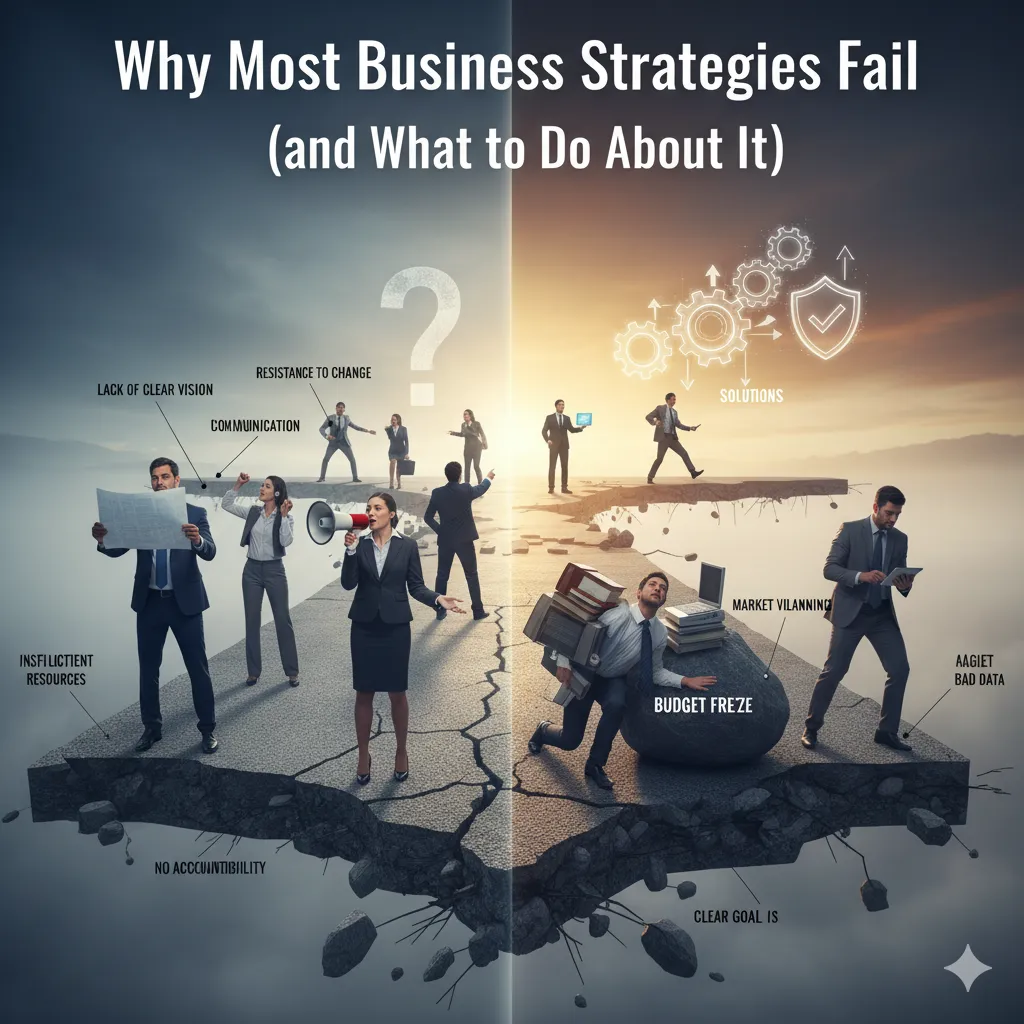
Know the Secrets Behind Business Strategy Failures
Introduction
As organisations craft bold visions and strategic plans, a surprising truth remains: many business strategies don’t succeed. Studies show that between 60-90% of strategic plans fail to fully deliver. This isn’t necessarily because the idea was flawed — often it’s because the plan didn’t translate into action, alignment, measurement and adaptation. In this blog I’ll walk you through the core reasons strategies fail, and offer practical approaches for what to do about it (so your organisation moves from “strategy on paper” to “strategy in practice”).
1. The Goal: Why we must ask “Why do strategies fail?”
When we set a strategy, the goal is not simply to have a document, but to change behaviour, to allocate resources, to align people, and to deliver outcomes. If any of these links breaks, the strategy is at risk.
Organisations spend time and energy creating strategies.
Yet many never achieve the desired outcomes.
Therefore: understanding why they fail is essential so we can adjust how we craft, implement and monitor strategy.
2. Evidence: Key reasons business strategies fail
Here are several major failure modes, backed by evidence and practitioner commentary.
2.1 Poor clarity & communication
Even the best strategy can collapse if people don’t understand it or their role in it.
A study found that only ~5% of employees could name more than one of their company’s strategic priorities.
If managers and frontline staff don't see how the strategy connects to their work, execution falters.
2.2 Unrealistic or vague objectives
If goals are not specific, measurable, realistic and time-bound, they lose traction.
Some strategies use “we’ll become market leader” without defining how, when, or by what measure.
Without a clear roadmap, teams don’t know what success looks like — and accountability drops.
2.3 Misalignment of resources & capabilities
A great strategy that lacks the right people, skills, budget or technology is doomed.
Inadequate resources (human, financial, technological) consistently show up as a root cause of failure.
Strategies that ignore what the organisation can realistically deliver often stumble.
2.4 Rigidity and insufficient adaptation
The business world moves rapidly. Strategies that are static or ignore changing conditions become outdated.
Many organisations stick to 5- or 10-year fixed plans even though markets evolve much faster.
Failure to adjust the strategy in light of new data, competition or customer feedback leads to irrelevance.
2.5 Lack of accountability and measurement
Without tracking progress, strategy becomes talk, not action.
When no one is accountable, initiatives slide, timelines slip, and nothing meaningful changes.
Many organisations never link strategic goals to measurable KPIs or live budgets.
2.6 Culture, behaviour and leadership gaps
Even perfect strategy will fail if leadership doesn’t live it, or culture resists it.
If senior leadership is not engaged, or the workforce isn’t involved in the strategy-making, buy-in suffers.
Also, if the organisation’s history, values or practices conflict with the strategy, execution suffers.
3. Outcome: What to do about it — a playbook for success
Knowing where failure occurs helps us build a better approach. Here are actionable steps you can apply to increase your chances of strategy success.
3.1 Define the why, what, and how clearly
Articulate the why (purpose) of the strategy: why this direction, why now?
Define the what: What are the priority goals? Make them specific and measurable.
Outline the how: What are the key initiatives, who owns them, and what’s the timeline?
Communicate this widely—ensure every team member knows how their work links to the strategy.
3.2 Align resources and build capability
Before launching, assess your current capabilities (skills, tech, budget) and identify gaps.
Prioritise initiatives: don’t overload the organisation with too many big changes at once.
Invest in upskilling, change management, tools and infrastructure to support the strategy.
3.3 Embed monitoring, accountability & adaptation
Define clear KPIs aligned with strategic goals. Set up dashboards or regular reviews.
Assign ownership: every initiative has a responsible person who is accountable.
Adopt a cadence of frequent check-ins (quarterly/ monthly) and decision points where you ask: Is this still working? Do we pivot or double-down?
Adopt an agile mindset: be ready to refine or change strategy given new inputs.
3.4 Engage and lead culture change
Leadership must be visible, active and aligned. Strategy must be lived, not just written.
Involve teams in strategy-making or cascading: when people contribute, they buy in.
Communicate progress and wins; celebrate milestones. Build the narrative of “we’re doing this together”.
Tackle resistance: provide training, set expectations, ensure people understand why the change matters.
3.5 Keep the strategy dynamic, not static
Build in flexibility: strategy should include guardrails and vision, but allow for adjustment.
Monitor external environment (market, competitors, technology) and internal signals (performance, culture) and ask: Is this still valid?
Don’t treat strategy as a once-a-year document; make it a living process.
4. Conclusion
The truth is: strategy is not a magic bullet. It’s a disciplined process of:
diagnosing where you are and where you want to go
designing the path and aligning the organisation
executing with clarity, capability and accountability
monitoring, learning and adapting
By understanding the common failure points and applying the actions outlined above, you can improve the odds that your strategy moves from “plan” to “performance”. If you keep the goal in sight (outcome), remain evidence-driven (data + execution), and focus on experience (people, culture, capability), you’ll be far better positioned for strategic success.
Perfect 👌 Here are 10 FAQs crafted for AEO (Answer Engine Optimization), LLM-readability (AI search understanding), GEO (Goal–Evidence–Outcome), and AIO/SEO structure — meaning these are ready to rank in Google, ChatGPT-like search tools, and AI overviews.
Topic: Why Most Business Strategies Fail (and What to Do About It)
FAQs
1. Why do most business strategies fail?
Goal: Understand the main cause.
Evidence: Studies show 60–90% of strategies fail due to poor execution, unclear goals, and weak communication.
Outcome: Success requires clear objectives, resource alignment, and consistent monitoring.
2. What are the top reasons business strategies fail?
Goal: Identify failure points.
Evidence: The most common reasons include vague goals, lack of accountability, rigid planning, poor leadership, and weak performance tracking.
Outcome: Defining SMART goals and building an adaptive execution framework increases success rates.
3. How can companies prevent strategy failure?
Goal: Learn prevention steps.
Evidence: Companies that align people, process, and performance measurement avoid common pitfalls.
Outcome: Use a continuous improvement loop — Plan → Execute → Review → Adjust.
4. What role does leadership play in successful strategy execution?
Goal: Explore leadership’s impact.
Evidence: Leaders set tone, alignment, and accountability. Research shows engaged leaders improve success rates by over 40%.
Outcome: Empower leaders to communicate, measure, and adapt strategy with transparency.
5. Why is communication critical in business strategy?
Goal: Understand the link between clarity and success.
Evidence: Only 5% of employees know their company’s main goals (Quantive).
Outcome: Frequent updates, simple language, and shared ownership turn strategy into daily action.
6. How does company culture affect strategic success?
Goal: Connect culture with performance.
Evidence: A culture misaligned with new goals creates resistance, delays, and disengagement.
Outcome: Foster a change-ready culture that rewards adaptability and teamwork.
7. What’s the difference between good strategy design and good execution?
Goal: Clarify execution vs. design.
Evidence: Design defines what to do; execution ensures it gets done.
Outcome: Combine vision (design) with management discipline (execution) for lasting success.
8. How can data and KPIs help prevent strategy failure?
Goal: Learn the value of data tracking.
Evidence: Real-time data dashboards and clear KPIs help leaders measure success and pivot early.
Outcome: Data-driven decision-making keeps strategy aligned with reality.
9. What should businesses do when a strategy starts failing?
Goal: Find recovery options.
Evidence: Companies that identify failure early and pivot improve recovery odds by 70%.
Outcome: Conduct a strategy audit — review goals, feedback, metrics, and adjust direction.
10. How often should a business update its strategic plan?
Goal: Understand timing and frequency.
Evidence: Annual reviews are no longer enough; agile businesses reassess quarterly.
Outcome: Adopt a “living strategy” approach that evolves with market data and performance insights.